


In this article
A carved pumpkin, a white ghost, a pointed witch hat and a black cat can identify Halloween before the word itself appears. Add a moonlit house, a skull or a bowl of candy, and the message becomes even clearer. Yet these images did not begin as one matching set, and they did not all enter Halloween at the same moment.
That is the idea behind the PaintEasy Halloween paint by numbers collection. It is not simply a group of dark pictures or orange-and-black artwork. The series brings together visual symbols shaped by harvest traditions, beliefs about the dead, European folklore, immigrant customs, Gothic storytelling and the later family ritual of trick-or-treating.
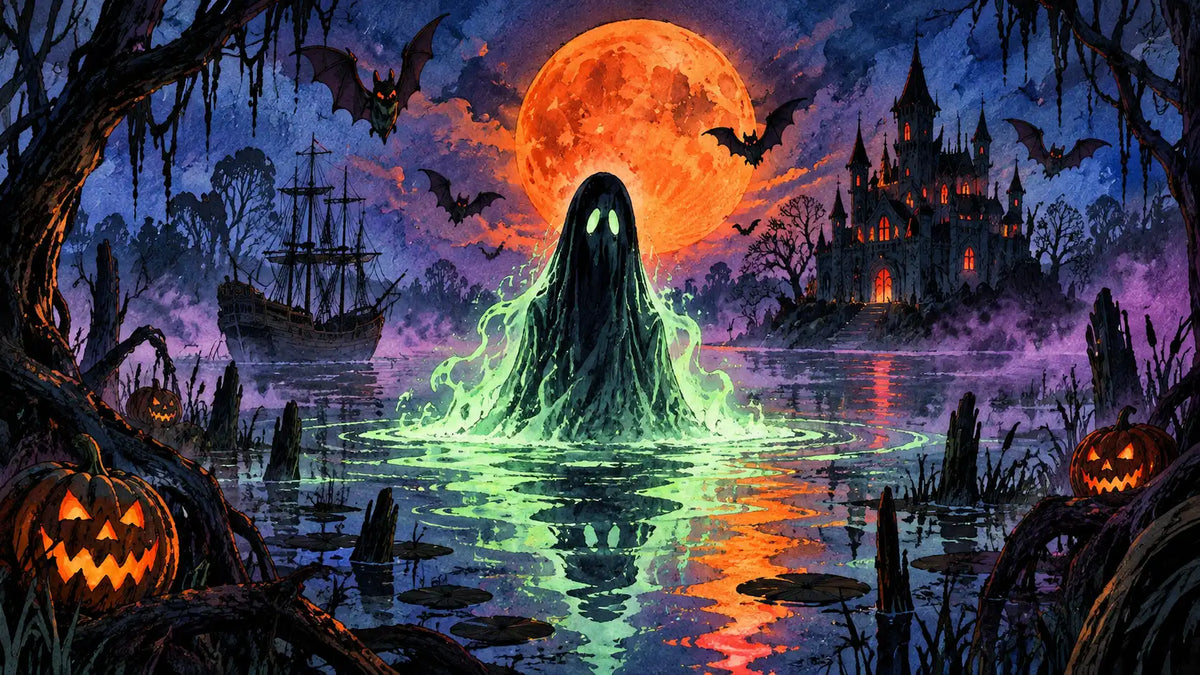
Halloween design works by recombining that shared visual language. The same pumpkin can feel welcoming beside candy and autumn flowers, mischievous when it grows a carved grin, or ominous beneath a haunted house. Understanding where the symbols came from explains both why this collection exists and why its products can range from cheerful little ghosts to much darker skeletal scenes without losing their Halloween identity.
Halloween Has a Layered Visual History, Not One Single Origin Story
Modern Halloween is often reduced to one sentence about the ancient Celtic festival of Samhain. Samhain is an important part of the story: it marked a seasonal transition at the end of the harvest, and traditions associated with it involved fire, disguise and a perceived closeness between the worlds of the living and the dead. But the Halloween recognized today was not copied intact from one ancient celebration.
All Hallows' Eve and the wider Christian season of Allhallowtide added their own focus on the dead. Irish and Scottish immigrants carried seasonal folklore, guising and vegetable-lantern traditions to North America. Later, postcards, children's parties, Gothic literature, stage imagery, horror films, community haunted houses and commercial decorations made the symbols more standardized.
This layered history matters when reading the collection. A ghost belongs to the holiday for a different reason from a pumpkin, while a haunted mansion entered the visual vocabulary differently from a bowl of candy. Product designers can still combine them because generations of Halloween imagery have taught viewers to read the group as one seasonal world.
Why Did Pumpkins Become the Face—and Light—of Halloween?
Jack-o'-Lanterns Were Not Originally Carved from Pumpkins
The carved face associated with Halloween developed from older lantern traditions in Ireland and Scotland, where people used turnips and other root vegetables. Irish folklore about “Stingy Jack” also helped attach the name jack-o'-lantern to a wandering light. When immigrants brought these traditions to North America, pumpkins provided a larger, more abundant and easier-to-carve surface.
That change joined two ideas that were already useful to Halloween: the pumpkin represented the autumn harvest, while the carved face and inner light suggested something supernatural. It could sit at the boundary between a welcoming seasonal decoration and a warning against what might be outside in the dark.
A Pumpkin Lets One Design Move from Autumn to Halloween
A plain pumpkin among leaves, flowers or a cottage can remain part of the wider Autumn paint by numbers collection. Carve a face into it, place it beneath a full moon or surround it with ghosts and witch hats, and the same harvest object becomes specifically Halloween.
That flexibility explains why pumpkins recur throughout the current Halloween range. Their rounded sections make a strong focal shape; orange stands apart from dark blue, purple and black backgrounds; and the face can determine the emotional direction of the entire picture. A small smile supports a cozy design. Sharp eyes and an exaggerated grin pull the same form toward horror.
In Little Witch with a Broom and Pumpkins, the pumpkins help make the character's world playful and seasonal. In Purple Haunted House with Glowing Pumpkins and a Full Moon, their light leads the eye along the path toward a darker destination. The object remains familiar, but its placement changes its role.
Why Are Ghosts Such an Immediate Halloween Symbol?
The Holiday Has Long Made Space for the Dead
Traditions surrounding Samhain and Allhallowtide both contributed to Halloween's attention to death, spirits and remembrance. The details varied by place and period, but the idea of an unusually open boundary between living people and the dead gave ghosts a natural place in the holiday.
The familiar white-sheet ghost is a much later piece of visual shorthand, not an ancient image preserved unchanged from Samhain. A draped costume could be made at home, read clearly at night and conceal the wearer. Illustration, theatre, photography, film and children's decoration then turned its rounded head, flowing body and dark eye holes into an instantly recognizable character.
A Ghost Can Be Friendly or Frightening with Very Few Changes
This simple silhouette is unusually adaptable in artwork. Pale cream, blue, gray or lavender can separate the body from a night sky, while the eyes and mouth carry most of the expression. Round eyes and raised arms can suggest a cheerful surprise; a stretched form, obscured face or cold glow can create unease.
That is why the collection can include both Friendly Ghost in a Pumpkin Meadow and Skull Train with Glowing Ghosts. One treats the ghost as a companion; the other treats it as an apparition. Painters who want that subject to remain central can move into the narrower Ghost paint by numbers collection, the closest subject route connected to the wider Halloween theme.
Why Do Witches and Black Cats Appear Together?
The Modern Witch Is a Composite Character
Today's Halloween witch—with a pointed hat, broom, cauldron, potion bottles and black clothing—did not arrive as one complete costume from a single historical source. The figure was assembled over centuries from European fears about witchcraft, folklore, printed caricature, literature, theatre and eventually cinema and television.
The result is a remarkably efficient piece of visual storytelling. A pointed hat establishes the character in silhouette. A diagonal broom creates movement. A cauldron or potion shelf explains what the character is doing. Product designs can keep those elements cute and rounded or make them sharp, shadowed and threatening.
The dedicated Witch paint by numbers collection continues beyond Halloween because magic and fantasy are broader subjects. Within Halloween, however, the witch is usually anchored by seasonal companions such as pumpkins, candy, bats, moons or ghosts.
Black Cats Inherited a Superstition They Did Not Earn
Black cats became linked to witches through European beliefs about familiars and stories that witches could disguise themselves as animals. Their dark coats also made them visually compatible with night, secrecy and the supernatural. Those beliefs later traveled into American Halloween imagery.
The superstition is neither a fact nor a universal cultural rule. Black cats have represented good fortune in other traditions, and the Halloween association should not be treated as a reason to fear or mistreat real animals.
As a design element, a black cat supplies a clean silhouette that remains readable against an orange moon, a glowing window or a field of pumpkins. Curved tails and bright eyes add character without requiring many objects. The Cat paint by numbers collection is the broader animal category—not a Halloween-only or black-cat-only collection—while designs such as Ghosts with Witch Hats, Candy and a Black Cat show how the cat enters a specifically Halloween scene.
Why Do Skulls, Skeletons and Haunted Houses Form the Darker Side?
Skeletons Make Mortality Visible
Bones have represented death and human mortality in many cultures, religious traditions and works of art. In Europe, memento mori imagery and the medieval Dance of Death made the skeleton a reminder that death reaches every social class. Gothic literature, stage entertainment and horror cinema later turned it into a figure that could also frighten, pursue or even dance.
Halloween could absorb that image because the holiday already made symbolic room for the dead. In a paint by numbers design, pale bones also create high contrast against black, crimson, blue or violet surroundings. A centered skull becomes an emblem; a full skeleton introduces gesture; repeated bones can establish a macabre rhythm. The Skull paint by numbers collection carries that subject beyond one holiday.
A skull should not automatically be described as Día de los Muertos imagery. Día de los Muertos is a distinct Mexican cultural observance with its own history, meanings and practices. A generic Halloween skeleton and a culturally specific calavera are not interchangeable simply because both depict bones.
Haunted Houses Turn Separate Symbols into a Place
The haunted house owes much of its familiar appearance to Gothic fiction, theatre, cinema and the rise of Halloween attractions. Turrets, broken windows, long staircases, bare branches and isolated buildings give fear an address. The house is less an ancient Halloween relic than a setting developed through later supernatural storytelling.
That setting changes product design. Instead of arranging icons on an open background, it gives the moon, ghosts, pumpkins and path a spatial relationship. A lit window suggests an unseen occupant. A path invites the viewer inward. Branches frame the building, while small jack-o'-lanterns can direct attention toward the entrance.
This is also where Halloween overlaps with the Gothic paint by numbers collection. Gothic is a year-round mood and visual style; Halloween is a specific seasonal occasion. A dark castle can be Gothic without containing Halloween symbols, while a smiling pumpkin-and-ghost scene can be Halloween without being Gothic.
Why Do Candy and Bright Colors Belong Beside the Macabre?
Trick-or-Treating Turned Halloween into a Neighborhood Ritual
Door-to-door Halloween customs developed through several traditions rather than one straight line. Medieval souling, Scottish and Irish guising, seasonal mischief and later North American community celebrations all contributed. During the twentieth century, organized trick-or-treating and commercial candy made the holiday increasingly centered on children, neighborhoods and shared play.
That is why candy, costumes and party scenes are not decorative afterthoughts in the series. They represent the social side of Halloween. The collection's trick-or-treat scenes depend on movement between homes and costumed figures, while Colorful Potion Bottles and Spooky Sodas turns the supernatural into a playful menu of small objects.
Those designs also provide a route for families who want seasonal imagery without horror. Bright sweets, round ghosts and expressive pumpkins sit naturally beside the wider paint by numbers for kids collection, although the suitability of any individual design should still be judged from its detail and product information.
Halloween Colors Are Design Tools, Not an Ancient Official Code
Orange works because it connects pumpkins, harvest and firelight. Black supplies night, shadow and strong contrast. Purple can suggest magic or twilight, while acid green often signals potions, unnatural light or modern monster imagery. White gives ghosts, moons and bones their visual separation.
These colors did not all carry one fixed Halloween meaning across history. Their present combination was strengthened by print, decoration, costume, film and retail design. PaintEasy products use the palette in the same flexible way: muted orange and lavender can feel cozy, while black, red and green can make an image more confrontational.
Why Do the Same Halloween Symbols Appear in Different Product Formats?
The current Halloween range uses individual canvases, Mini Sets and three-panel designs. Those formats are not simple size variations. Each one changes how the symbols tell the story.
An Individual Canvas Gives One Character or Scene the Lead
A single canvas can build a clear hierarchy. The main subject might be a witch, one large jack-o'-lantern or a haunted house, while smaller moons, bats, candy or flowers support it. This format works when one image needs to read as a complete seasonal scene from a distance.
A Mini Set Turns Halloween into a Collection of Visual Icons
Independent small paintings can separate the visual vocabulary into individual moments: one potion bottle, one ghost, one pumpkin character or one spooky drink at a time. Repeated color and illustration style keep the set coordinated even when each picture is complete on its own.
That structure suits Halloween particularly well because its symbols are already recognizable in isolation. It can also support a shared painting activity or a flexible finished arrangement. The broader Mini paint by numbers collection includes many non-Halloween subjects too; “Mini” describes the compact set format, not the holiday.
A Triptych Lets the Eye Travel Through a Halloween World
Three panels create room for sequence and repetition. Black Cat, Books and Pumpkin Triptych distributes a cozy still life across the set, while Gothic Castle Black Cat Halloween Night Triptych uses architecture, a red moon, bats and roses to sustain a darker atmosphere. Repeated moons, branches or colors help the eye cross the two physical gaps.
This makes a triptych useful when atmosphere matters as much as one central icon. It can spread a narrative across a wall or divide related scenes into a fixed order. The 3 Panel paint by numbers collection is the format branch for comparing that relationship across Halloween, floral, landscape and other subjects.
Where Does Halloween Sit Among PaintEasy's Related Collections?
Many Halloween designs also sit within the broader Holiday paint by numbers collection, but the two pages do not serve the same purpose. Holiday is the wider destination for calendar celebrations. Halloween is the focused series where harvest objects, supernatural figures, costumes and night scenes work together around October 31.
The other connections are intersections rather than perfectly nested categories. Ghost is the closest narrow subject branch. Witch, Skull and Cats continue their subjects outside Halloween. Autumn shares pumpkins, falling leaves and warm landscapes but does not require the supernatural. Gothic shares darkness, old architecture and macabre atmosphere but does not require the holiday.
The surrounding context decides where a picture belongs. A cat portrait remains a cat painting; a black cat beneath a moon among carved pumpkins reads as Halloween. A farmhouse beside uncarved pumpkins can remain autumnal; add luminous ghosts and a witch's hat, and it crosses into the Halloween series.
What Makes the Collection Feel Like One Series?
The products do not need one mood, one format or one level of scariness to belong together. Their unity comes from a recognizable set of relationships:
- Harvest becomes supernatural when pumpkins acquire faces, inner light or ghostly companions.
- Night becomes readable through moons, glowing windows, pale spirits and bright eyes.
- Folklore becomes character design through hats, brooms, cauldrons and black-cat silhouettes.
- Mortality becomes macabre imagery through skulls, skeletons and spectral figures.
- Fear becomes play through candy, costumes, friendly expressions and neighborhood scenes.
A product can emphasize any one of those relationships and still feel unmistakably Halloween. That is why the collection can support a smiling ghost Mini Set, a witch-led single canvas and a dark skeletal triptych without becoming arbitrary.
Browse the Halloween paint by numbers kits by looking first at the symbol that draws you in, then at what the design does with it. The subject may be familiar; the combination of expression, light, setting and format is what gives each painting its own version of Halloween.