


In this article
A black background does not automatically make a picture Gothic. Neither does adding a skull, a raven or a full moon. One of the clearest examples in PaintEasy's current range is a bright white cathedral interior: it contains none of the darkness people often expect, yet its pointed arches, rose window, statues and soaring perspective make its Gothic identity immediately visible.
The same PaintEasy Gothic paint by numbers collection also contains candlelit corridors, black-winged angels, antique bedrooms, ravens in libraries, floral anatomy, crystal balls and moonlit gates. These subjects do not come from one period or one artistic movement.
What holds the collection together is a layered visual language. Medieval architecture supplies the arches, vertical scale and stained glass. Gothic Revival returns those forms to later buildings and interiors, while Gothic fiction turns old spaces into places of memory and suspense. Dark-romantic design brings in roses, lace, velvet, mourning and mortality. Modern fantasy and goth imagery recombine those elements into portraits, mystical still lifes and supernatural scenes.
The First Gothic Was Built for Height and Light—not Horror
Medieval Architecture Gave Gothic Its Structural Vocabulary
Gothic architecture developed in northern France during the twelfth century and spread across Europe. Pointed arches, rib vaults and flying buttresses helped redistribute the weight of large buildings. Walls could rise higher and open into larger stained-glass windows, filling churches with colored light.
Those buildings were not designed as haunted settings. Their scale, elevation and light served religious and civic purposes. The modern assumption that Gothic must mean dark or frightening overlooks the brightness and color that were central to many medieval interiors.
That architectural foundation is still visible in White Gothic Cathedral Hall with Marble Statues, Candlelit Gothic Cathedral Hall and Gothic Cathedral Altar with Red Rose Stained Glass. The pointed openings repeat upward; columns establish rhythm; circular and stained-glass windows create a destination for the eye. Even when later designers change the colors or add fantasy details, the underlying structure remains recognizably Gothic.
The Name “Gothic” Acquired Its Darker Associations Later
Medieval builders did not use “Gothic” as the name of a horror style. Renaissance critics later applied the word dismissively to architecture they considered irregular or “barbaric” when compared with classical models. Centuries after that, the Gothic Revival deliberately returned to medieval forms.
During the eighteenth and nineteenth centuries, antiquarians and Gothic Revival designers—and then Romantic artists and writers—looked at castles, abbeys and ruins through changing emotional lenses. Age, weathering and incompleteness made the buildings feel connected to a lost past. The architecture could suggest grandeur and beauty while also leaving room for secrecy, isolation and unease.
Gothic Fiction Turned Architecture into a Story
A Castle Became More Than a Building
Horace Walpole's The Castle of Otranto, published in 1764, is widely treated as an early landmark of Gothic fiction. In this new literary use, medieval-looking architecture was not merely scenery. Castles, underground passages, locked rooms and inherited estates allowed the past to exert pressure on the present.
That idea explains why a Gothic picture often seems to contain a story even when no action is shown. A gate asks what lies beyond it. A corridor hides its destination. An illuminated window implies an unseen occupant. An old portrait introduces someone who may be absent, dead or still important to the room.
In Moonlit Cemetery Gate with Full Moon, the gate is both a physical object and a boundary between ordinary ground and a place associated with the dead. Candlelit Gothic Stone Corridor uses repeated arches and a central vanishing point to pull the viewer toward an unseen end. Moonlit Gothic Castle Gate with Purple Roses softens the entrance with flowers, but the mist, ironwork and distant building preserve its uncertainty.
When the building itself is what interests you most, it helps to separate Gothic architecture from castle imagery in general. A bright fantasy palace or historic fortress is not automatically Gothic; the arches, vertical structure, atmosphere and narrative role of the building make the difference.
An Empty Room Can Imply an Entire Character
Gothic interiors often tell stories through absence. Vampire Parlor and Red Velvet Chair does not need to show its resident. The empty chair, wine glass, roses, portrait and moonlit window supply enough evidence for the viewer to imagine one. In Gothic Raven Library at Moonlight, books, a clock, ink and candlelight turn the bird into the apparent witness to a room full of accumulated knowledge.
The two canopy-bedroom designs use the same principle in different tones. Burgundy velvet and dark mirrors create theatrical weight in one; pink curtains and roses make the other more romantic. Both remain Gothic because the room feels inherited, enclosed and emotionally charged—not because every surface is black.
What Makes Art Gothic Instead of Simply Dark?
The Past Remains Active in the Present
Gothic imagery rarely treats age as neutral decoration. Old books, clocks, cameos, portraits, cathedrals and weathered gates suggest that something has survived. The object may preserve memory, record a loss or imply a story that the present cannot fully escape.
Gothic Moon Pocket Watch and Feathers makes time itself the central object. Vintage Cameo Portrait Pendant with Dark Floral Frame places a face inside an inherited-looking form. A library, chapel or antique bedroom does similar work on a larger scale: it surrounds the viewer with traces of other lives.
Beauty and Unease Occupy the Same Frame
Direct horror can aim for shock, disgust or immediate fear. Gothic design often works through contradiction. Roses grow beside bones. Pearls and lace surround an obscured face. A beautiful room feels too still. A winged figure appears powerful and sorrowful at the same time.
This is the logic behind Octopus Queen with Exposed Ribcage and Rose Crown. The exposed anatomy introduces mortality, while flowers, jewelry and aristocratic styling prevent the image from becoming a straightforward medical or horror illustration. Rose Bride and Floating Crown combines ceremonial clothing, absent identity, red roses and dark drips. The tension comes from the beauty that remains beside what has gone wrong.
The Image Withholds Part of Its Meaning
A Gothic composition does not need to explain everything. A closed door, a turned figure, a mirror, a partially lit face or an empty chair can keep the viewer between several possible stories. That withheld information creates suspense without requiring a visible monster.
Gothic is therefore not a checklist of black objects. In many designs in this collection, it emerges from a relationship among age, beauty, mortality and something left unresolved. A moon or rose can participate in that relationship; the same object can belong to a completely different style in another setting.
Why Light Matters More Than a Black Palette
Moonlight Creates Distance and Solitude
A moon does two jobs in many current designs. It establishes night, but it also creates a remote light source. Figures, ravens, gates and towers become silhouettes between the viewer and that distant circle. The surrounding space can remain cool and uncertain while the subject stays readable.
Raven on Iron Gate under Full Moon uses that arrangement directly. In Dark Gothic Angel with Black Wings and Moonlit Roses, the moon separates the wings from the sky and gives the seated figure an isolated stage. The moon is not historically exclusive to Gothic art; its design value comes from what it reveals and how much darkness it leaves around the subject.
Candlelight Makes an Interior Intimate but Incomplete
A candle illuminates only a limited area. That makes it useful in rooms filled with books, curtains, glass, portraits or old furniture. The nearest object receives warmth and attention, while the rest of the room can recede into shadow.
In Gothic Rose Teacup and Candle, candlelight transforms an ordinary still life into a private nocturnal moment. In the cathedral hall and stone corridor designs, repeated flames mark a route through a much larger space. The light offers guidance without making the entire setting knowable.
Why Roses, Ravens, Clocks and Anatomy Belong Together
Roses, Lace, Pearls and Velvet Create Dark Romance
None of these materials belongs exclusively to Gothic history. Roses can express love, beauty, grief or transience; lace and pearls can suggest ceremony, intimacy or inherited elegance; velvet gives rooms and clothing visual weight. Modern Gothic design places them beside night, decay, absence or mortality so that refinement never feels entirely safe.
Gothic Violin with Red Roses, Gothic Masquerade Mask and Pearls and Gothic Portrait with White Roses and Drapery rely on this dark-romantic branch rather than haunted architecture. They also overlap with the Vintage paint by numbers collection, where antique rooms, nostalgic objects and historic styling continue without necessarily carrying Gothic tension.
Ravens, Moths and Black Cats Act as Witnesses
A raven was not a standard emblem of medieval Gothic architecture. Its modern Gothic force comes from broader associations with death and omen, reinforced especially by literature such as Edgar Allan Poe's 1845 poem The Raven. In visual design, its dark silhouette remains legible against a moon, stained glass or candlelit wall.
The animals in the current collection are usually positioned as observers. A raven perches above books or an iron gate. A black cat sits at a moonlit window. Moths circle a glass terrarium. They give the eye a living focal point while making the surrounding room or landscape feel watched.
Clocks, Portraits and Anatomy Keep Mortality Visible
Skulls, skeletons and anatomical forms belong to a much wider history of mortality imagery; Gothic did not invent them. Their role here is contextual. A ribcage surrounded by roses or floral lungs against a dark ground holds life and death in the same image. A clock makes passing time visible. An old portrait lets a person remain present after their moment has passed.
When bones or skulls become the primary subject rather than one part of a dark-romantic composition, the narrower Skull paint by numbers collection is the more direct route.
Why the Collection Includes Portraits, Angels and Occult Objects
Gothic Figures Turn Atmosphere into Identity
A cathedral externalizes Gothic through architecture. A portrait can bring the same visual language onto the body. Black wings, ornate capes, lace, crowns, flowers, exposed anatomy and controlled expressions allow a person to appear caught between roles: sacred and fallen, powerful and vulnerable, living and spectral.
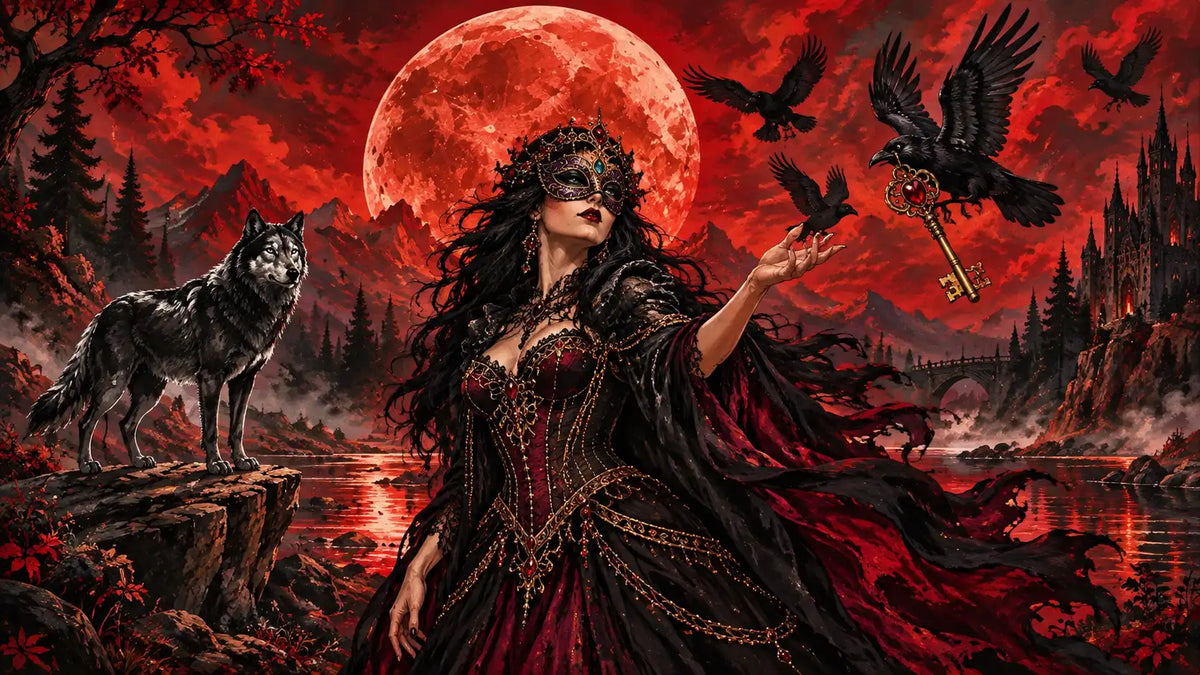
The current range uses this approach in dark angels, a headless bride, an octopus queen, Crimson Moon Witch with Black Crows and other central figures. These works overlap naturally with the broader Portrait paint by numbers collection, where the face or human figure remains the main subject across many styles.
PaintEasy also carries photo-based Gothic character transformations, including a black-winged dark angel and a moonlit portrait with black roses. They connect the ready-made collection to custom paint by numbers from a photo: instead of painting an invented Gothic figure, the sitter becomes part of the visual story.
Tarot, Crystal Balls and Alchemy Are Later Extensions
Tarot cards, potion bottles, all-seeing eyes, crystals and alchemy rooms are not defining features of medieval Gothic architecture. Nor do they share one origin: alchemy has medieval and early-modern histories, while tarot began as card play before later occult interpretation. Their present combination as a Gothic-looking visual world owes more to later occult revival, supernatural fiction, fantasy and contemporary dark aesthetics.
The surrounding treatment determines whether those objects read as Gothic. Purple Gothic Crystal Ball with Moonlit Window places its central glow among candles, antique books, ornament and an arched window. Gothic Raven Alchemy Chamber with Emerald Glass uses stained glass, brass instruments, smoke and old volumes to make the display feel accumulated rather than futuristic.
This branch expands the series without changing its central logic: an old-looking space, a restricted source of light, symbolic objects and an unresolved story work together.
Modern goth culture adds another, much later layer. It emerged from late-1970s and early-1980s post-punk rather than descending unchanged from the Middle Ages. Its fashion and visual identity selected from Gothic literature, horror, glam, Victorian references and other dark aesthetics. Contemporary Gothic product design is similarly selective: it combines sources instead of reproducing one historical period.
Is Gothic the Same as Halloween or Horror?
Gothic and Halloween Are Related Peers
Halloween is a seasonal celebration category. Pumpkins, trick-or-treating, candy, costumes and October rituals can make a design Halloween even when it is cheerful and cartoon-like. Gothic is a year-round architectural, literary and visual mode. It can exist in a cathedral, library, bedroom, portrait or floral still life without using any holiday symbol.
The two categories overlap when a Halloween scene also uses Gothic architecture, dark romance or a sense of inherited mystery. Gothic Castle Black Cat Halloween Night Triptych belongs to that intersection: the pumpkin and Halloween night establish the holiday, while the castle, ironwork, roses and dramatic red moon establish the Gothic treatment.
This makes the Halloween paint by numbers collection a same-level related series—not the parent or child of Gothic. Most current Gothic designs remain usable beyond October, while most Halloween designs are organized around the occasion.
Gothic Can Contain Horror Without Depending on It
Horror describes an intended genre or emotional effect; Gothic supplies recurring settings, symbols and preoccupations. Either can appear without the other, and one image can clearly be both. A luminous cathedral may be Gothic without trying to frighten, while a bodily threat can be both horrifying and Gothic when it is placed inside the collection's older architecture, inherited histories or dark-romantic tensions.
Gothic Is a Relationship, Not a Checklist
A pointed arch can provide historical structure. A castle or empty room can make the past feel present. Moonlight and candles can reveal one object while concealing another. Roses, lace and anatomy can hold beauty beside mortality. A raven, portrait or clock can imply a witness, a memory or the passage of time.
No single element is enough by itself. Gothic emerges from the way those elements interact—and from the story the image deliberately leaves unfinished.
Explore the Gothic paint by numbers designs with those layers in mind. The cathedral, raven, rose or candle may catch your attention first; the relationship between architecture, light, history and emotion is what makes the finished composition Gothic.