


In this article
Ask someone to picture a cityscape and they may imagine a row of skyscrapers against the sky. That is one kind of cityscape, but it is not the whole category. A canal bordered by narrow houses, a village street winding between stone cottages, a lighthouse above a harbor and a castle overlooking a town can all tell us how people have shaped a place.
This broader idea explains the range inside PaintEasy's Cityscape paint by numbers collection. Its strongest group is still city scenery: skylines, famous landmarks, historic streets, bridges, canals and waterfronts. Around that center are related routes organized by building type, settlement and destination. Together they answer a more interesting question than “Which city is this?”: what makes a place recognizable when it becomes a painting?
There are three possible answers. The structure of the place can lead through streets, towers and waterways. A destination can be identified through its architecture, geography and everyday details. Or the meaning can come from a personal photograph—the exact view remembered by the person who stood there.
A Cityscape Is a Place Shaped by People
The Built Environment Carries the Picture
In visual art, a cityscape is an urban counterpart to a landscape. Buildings, streets and other constructed spaces provide the main structure, even when sky, water, trees or hills occupy a large part of the image.
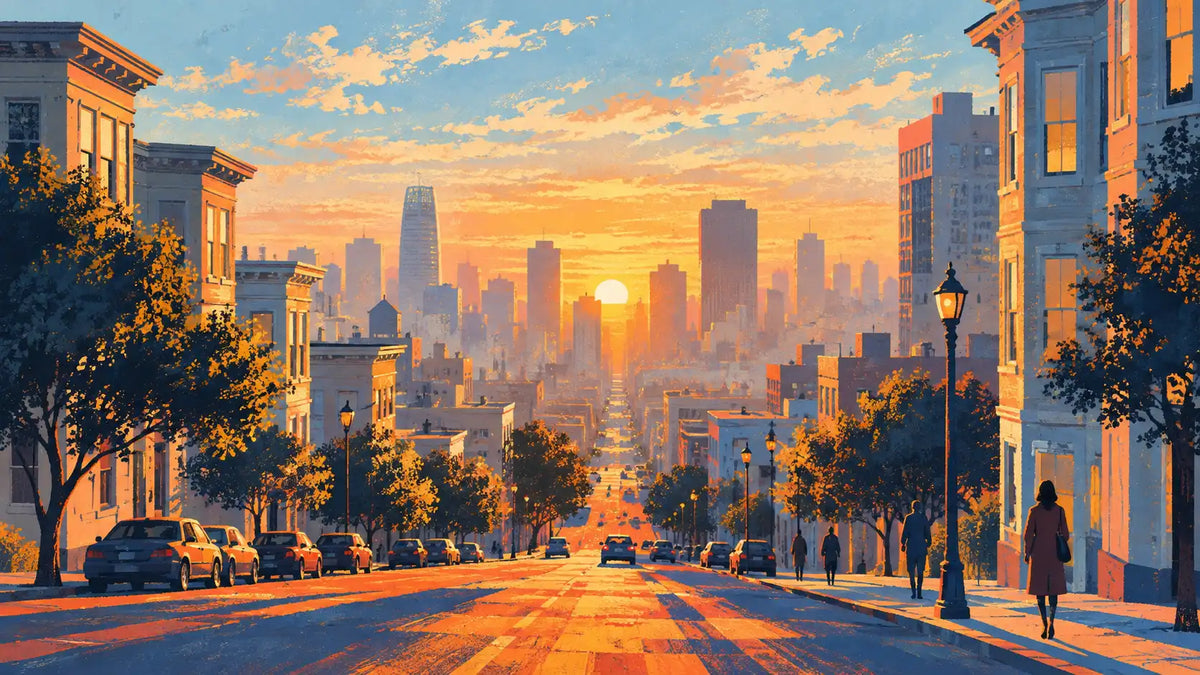
Golden Sunrise Skyline with City Rooftops is clearly led by its mass of buildings. In Violet Canal Bridge with Gondolas in Evening Mist, the water occupies more space, but the bridge, canal edges and surrounding architecture determine the identity of the scene. Sunlit Cobblestone Alley with Blooming Flowers depends on walls, windows, doors and the route of the street rather than on one famous monument.
A person or vehicle may appear inside a cityscape without becoming its primary subject. A yellow taxi helps a New York street feel inhabited; a bicycle makes an Amsterdam canal feel local; a boat gives scale to a waterfront. The place remains the organizing subject.
A Cityscape Does Not Require Skyscrapers
“Cityscape” and “skyline” are not synonyms. A skyline is the outer profile of buildings seen against the sky. A cityscape can bring the viewer much closer—to a market street, a bridge, a courtyard, a station entrance or the view from a window.
The term “townscape” is sometimes used for smaller or less urban settings, but the visual principle is similar. A row of houses, an old bell tower and a narrow road can establish a complete built place. This is why Stone Village Lane beneath Green Hills still belongs beside denser urban views: the village architecture and street lead the composition, while the hills establish its setting.
When Nature Leads, the Image Becomes a Landscape
The boundary is determined by visual emphasis, not by whether one building happens to be present. A mountain panorama with a tiny cabin remains primarily a landscape. A coastal painting in which the lighthouse controls the route of the eye can be read through architecture as well as scenery.
For mountains, forests, lakes and beaches in which the natural environment remains dominant, the broader Landscape paint by numbers collection is the clearer route. The two categories meet at village edges, waterfronts and scenic overlooks, where built and natural forms share the composition.
The Collection Uses Two Different Maps at Once
PaintEasy's Cityscape navigation can be read in two ways. One route begins with the kind of place or structure in the picture. The other begins with its geographic identity. These are complementary ways of browsing, not competing definitions.
One Map Sorts Places by Their Built Character
A painter may not have a particular country in mind. They may simply want a quiet rural road, a coastal beacon or an old fortress. The architecture-first routes serve that interest.
The Countryside paint by numbers collection moves away from dense urban streets toward village edges, rural lanes, canals, docks and small settlements. Farm, barn and cottage themes narrow the view further, placing more attention on agricultural life or one intimate building.
The Lighthouse paint by numbers collection is organized around a functional landmark and its relationship with coast, weather and water. A lighthouse can stand inside a harbor town, on an isolated cliff or in a simplified children's scene; the repeated subject matters more than one specific destination.
The Castle paint by numbers collection crosses historic city views, mountain fortresses, Gothic settings and fantasy architecture. Some castles identify a real place. Others construct an imagined world. In both cases, the building supplies the visual center.
These pages are best understood as related architectural and settlement routes. They do not need to duplicate every product inside Cityscape to help shoppers move from a broad place-based collection toward the kind of structure they want to paint.
The Other Map Sorts Places by Destination
Destination pages begin with where rather than what. A city collection can stay tightly focused because one city has a finite set of recognizable districts, structures and viewpoints. The New York paint by numbers collection, for example, can move between DUMBO, Times Square, Central Park, Grand Central Terminal, the Flatiron Building, Brooklyn Bridge and the Manhattan skyline while retaining one geographic identity.
That difference is explored more closely in PaintEasy's guide to New York streets, bridges, parks and skyline views. It compares DUMBO, Brooklyn Bridge, Times Square, Grand Central and Central Park by viewpoint, showing why several paintings of one city do not represent the same visual experience.
The Amsterdam paint by numbers collection is held together differently. Canals, narrow gabled houses, arched bridges, boats, bicycles and reflected evening light create a recurring visual system. One landmark is less important than the relationship among water, street and architecture.
Country and regional pages naturally have a wider job. Italy may include Venetian canals, Roman ruins, Tuscan fields and cliffside towns. India can move between the Taj Mahal, Varanasi, Jaipur, Ladakh, Kerala and Mumbai. The place name holds several landscapes and cultural histories rather than one urban silhouette.
A Place Can Be Recognizable Without Its Name
Landmarks Act Like Visual Signatures
A famous landmark offers the quickest form of recognition. The Statue of Liberty, Eiffel Tower, Big Ben, Taj Mahal and Sydney Opera House each have an outline that can identify a destination before the surrounding details are read.
That makes a landmark useful in a painting, but it does not make every landmark composition identical. The same tower can be viewed from a river, framed by trees, approached along a street or isolated against open sky. The viewpoint determines whether the picture feels monumental, intimate, busy or distant.
A landmark answers “where”; its surroundings answer “what was it like to be there?” Bridges, weather, traffic, water, plants and nearby buildings turn an icon into a place.
Ordinary Street Details Create Local Identity
Some of the most specific clues are not monuments. Red telephone boxes and wet pavement can make a London scene legible. Yellow taxis and brick warehouse streets distinguish different views of New York. Canal boats, bicycles and narrow façades give Amsterdam its rhythm. White walls, blue domes and windmills change the visual language of a Greek island town.
These details work because they belong to the way a place is used. Transport, shopfronts, street furniture, roof shapes and building materials show everyday life at the scale of the pedestrian. They also prevent a country or city collection from becoming a series of isolated postcard monuments.
Geography Changes the Meaning of Architecture
A building never appears independently of its terrain. Hills compress houses into stacked layers. Canals create long reflections and repeated bridge arches. A harbor places boats and quays between the viewer and the town. Mountains make a fortress feel defensive; an open plaza makes a palace ceremonial.
This relationship is visible in the India paint by numbers collection. The symmetry of the Taj Mahal and its reflecting pool creates a different place experience from Varanasi's layered riverfront steps, Kerala's tropical backwaters or a Ladakh monastery beneath the Himalayas. The country connects them, but geography changes the composition.
A Country Collection Needs More Than a Capital Skyline
Architecture Is the Starting Point, Not the Whole Story
PaintEasy's current destination range is still weighted toward urban views, landmarks and scenery, but several country collections already extend beyond them. Australia combines Sydney architecture with Uluru, eucalyptus, koalas, kangaroos and coast. Madagascar moves through baobabs, lemurs, shore boats and island wildlife. Spain connects churches, Moorish arches and stone streets with coast and flamenco figures.
The Japan paint by numbers collection shows how several kinds of recognition can coexist: Tokyo towers and crowded streets, pagodas and temples, Mount Fuji, bamboo forest, rice fields, a torii gate and the Great Buddha of Kamakura. No single subject is expected to stand for the entire country.
Food, Craft and Traditional Motifs Can Add Human Context
As destination collections expand, local food, markets, textiles, craft, everyday transport, ceremonies and regional symbols can make the idea of place more human. These additions should not function as decorative labels pasted around a skyline. Each design needs one coherent scene or relationship.
A café table can show how people occupy a street. A market can connect produce, architecture and daily movement. A textile or traditional motif can be placed in a setting that explains how it is used. A food still life can lead into a destination when the ingredients, tableware and surroundings are specific enough to tell a local story.
Care also matters. A symbol should be identified accurately rather than used as a generic “exotic” pattern, especially when it belongs to an Indigenous, religious or ceremonial tradition. Cultural specificity is strongest when the design shows context, not when it collects stereotypes.
A Country Is Not One Visual Formula
A national collection becomes more useful when it acknowledges regional difference. Coastal and inland life, old and modern architecture, rural and metropolitan views, climate, food and local traditions may change greatly within one country.
This creates a clear content structure. City pages can remain focused on one urban destination. Country and regional pages can bring several cities, landscapes and cultural subjects together. Cityscape remains the built-environment branch, while the wider destination family explains how architecture belongs to a fuller sense of place.
Ready-Made Views and Personal Travel Memories Serve Different Purposes
A Ready-Made Cityscape Holds Shared Recognition
A designed New York, Paris or Santorini scene begins with a view many people already recognize. It may represent a trip already taken, a future destination or simply an attraction to the architecture. Its meaning is open enough for different painters to enter.
These designs also allow the artist to choose an idealized viewpoint: the bridge at sunset, the canal with balanced reflections or the landmark framed by flowers. They preserve a shared image of a place rather than one person's exact moment.
Your Travel Photograph Holds the View Only You Saw
A personal travel memory is often less perfect and more specific. It may be the street outside a hotel, the lighthouse reached after a long walk, the view through a train window, a family member crossing a plaza or a café where rain interrupted the afternoon. The location matters, but so does what happened there.
PaintEasy's product page allows you to turn your own travel photo into a custom paint by numbers kit. The current custom option accepts travel, landscape and architecture photographs and provides a preview before production, so the crop and main subject can be checked before the canvas is made.
Keep the Detail That Carries the Memory
The best source photograph is not necessarily the widest panorama or the most famous angle. Begin by identifying the detail that makes the image yours. If the memory is a person standing beneath a landmark, that person must remain large enough to read. If it is the view from a balcony, keep enough of the railing or window to preserve the viewpoint. If it is a street discovered by accident, the turn of the road may matter more than the distant tower.
Use the clearest original photograph available and look for visible separation between the important shapes. Extremely dark night scenes, distant faces and crowds of tiny objects may need more simplification. A crop that protects the subject is usually more valuable than trying to retain every building at the edge of the frame.
A custom conversion will translate the photograph into numbered color areas rather than reproduce every pixel. That transformation is part of the result: the finished work records both the journey and the time spent repainting it by hand.
A Cityscape Can Be Famous—or Entirely Yours
A cityscape is not defined by the height of its buildings. It is defined by the role of the built place: the route of a street, the edge of a harbor, the repetition of canal houses, the presence of a landmark or the way a settlement meets its surrounding land.
That is why one collection can connect modern skylines, old towns, castles, lighthouses and destination pages without pretending they are identical. One route begins with architecture. Another begins with geography and culture. The most personal route begins with a photograph and a memory.
Explore the Cityscape paint by numbers designs for a place you recognize, hope to visit or want to see from a new angle—or begin with the view that already belongs to your own journey.