


In this article
Children do not build confidence simply by being told they are capable. They build it through experiences that allow them to discover their own ability.
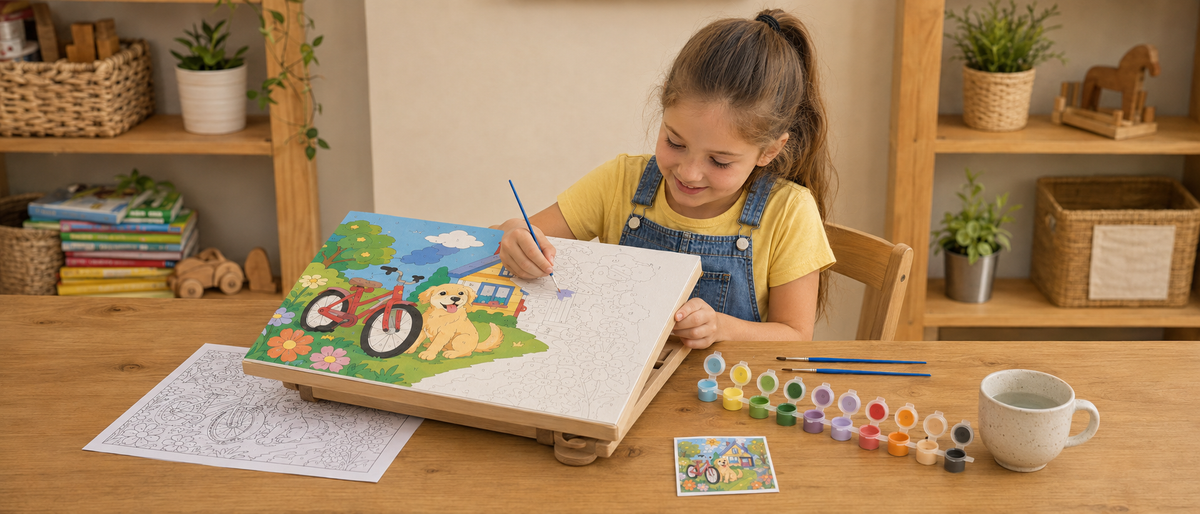
Paint by numbers offers children a structured but independent creative journey. They know where to begin, can see what comes next, and do not need an adult to correct every choice or guide every step. This sense of ownership matters. It allows a child to say, “I worked it out,” rather than, “Someone helped me do it.”
PaintEasy sees every finished painting as more than a completed craft. It can become a personal record of independence, persistence, and growing self-efficacy—helping a child form a stronger sense of identity: “I am capable, and I can create something of my own.”
Why PaintEasy Created Kids Collection for What Children Truly Lack
Learning to Wait for Something Worth Completing
Some children appear highly confident but struggle when success does not come quickly. Boasting, dismissing a task, or acting superior can sometimes protect a more fragile belief: “If I cannot succeed immediately, perhaps I should pretend it was never worth trying.”
What these children may lack is not encouragement, but experience with delayed gratification. They need opportunities to slow down, remain with a process, and discover that meaningful results are not always immediate.
Paint by numbers offers visible progress without instant completion. A child fills one section, then another, gradually watching the whole picture emerge. The process teaches that frustration does not require escape, effort does not need an immediate reward, and waiting can make the final achievement feel more meaningful.
Accepting Imperfection Without Rejecting Themselves
Children need to know how to face an imperfect result without turning it into a judgment about who they are. A color may cross a line, two shades may be confused, or the completed picture may look different from what they imagined. These moments are small, but the way a child responds to them matters.
A manageable creative project gives children a safe place to make mistakes, adjust what they can, and continue with what they cannot change. They gradually learn that an imperfect section does not ruin the entire painting—and making a mistake does not make them a failure.
The goal is not to teach children to stop caring about quality. It is to help them care without becoming afraid: to try seriously, accept the outcome honestly, and remain willing to begin again.
Building Self-Worth Through Real Accomplishment
Self-worth becomes fragile when it depends entirely on praise, grades, comparison, or being told, “You are amazing.” Children also need evidence they can recognize for themselves: “I completed this because I stayed with it.”
PaintEasy begins with projects that children can genuinely understand and complete. Each finished section connects effort with progress, while the completed painting provides a visible record of patience and ability. Completion itself becomes positive feedback rather than merely a reason to receive adult approval.
As children move gradually from manageable paintings to more challenging ones, their confidence gains a firmer foundation. They do not have to believe they can do everything. They begin with the quieter and more reliable belief that they can learn, improve, and finish something within their reach.
Discovering the Value of Creating for Others
A child’s world naturally begins with personal wants, feelings, and achievements. Growth includes learning that their abilities can also create something meaningful for another person.
A finished painting can become a birthday gift, a decoration chosen for a family space, or part of a shared parent-and-child project. In these situations, children experience more than the pride of ownership. They see that their time, attention, and creativity can bring happiness, comfort, or connection to someone else.
This is where self-interest and care for others begin to support each other. Children still enjoy creating, but they also discover a broader form of value: “Something I made can matter to another person.”
Finding a Personal Connection with the World
Children build identity not only by looking inward, but also by discovering what draws them toward the world. The subjects they choose can reveal curiosity, affection, imagination, and emerging aspirations.
PaintEasy therefore includes themes that give children different ways to connect:
- Landscape designs encourage interest in nature, places, seasons, and environments beyond everyday life.
- Growth imagery, such as trees, gardens, journeys, and changing seasons, gives children visual ways to understand development and change.
- Career themes allow them to imagine future roles and explore how personal interests might become useful abilities.
A painting cannot decide who a child will become. It can, however, serve as a connecting point—between the child and nature, family, personal growth, future possibilities, and the wider world they are gradually learning to enter.
What Children Learn Through Painting at Every Age
Ages 3–5: Building an Early Sense of Order
At this age, children can begin with images of familiar things they can understand at a glance. A small animal standing in a meadow, a rainbow after the rain, or a simple scene made up of sunshine, flowers, and a house gives them a clear subject and a stable visual structure. They do not need to understand a complicated story before recognizing where each element belongs or finding an obvious place to begin.
PaintEasy artwork for this stage therefore uses a single main subject, large enclosed color areas, smooth outlines, and clean backgrounds. Animals have friendly, easy-to-read expressions, while rainbows and gardens use clear, recognizable color relationships. As children search, match, and fill each section, they experience how order gradually emerges from a series of small actions.
Ages 5–7: Developing the Determination to Continue
Between five and seven, children are ready for pictures with a goal that feels slightly farther away—something they must gradually work toward. A castle on a hill, a lighthouse by the sea, or an adventure scene unfolding along a bridge or pathway does not reveal itself in the first few steps. Children must complete the walls, windows, sky, and road before they can see the whole story take shape.
PaintEasy gradually increases the number of color areas at this stage. Repeated elements such as castle windows, waves, and clouds create a steady painting rhythm without becoming overly small or tedious. Lighthouses, pathways, and distant buildings give the composition a sense of direction, turning persistence from an abstract expectation into a process in which children can actually see themselves moving closer to a goal.
Ages 7–9: Discovering What Makes Me Unique
Between seven and nine, children begin to notice which parts of the world genuinely interest them. Some are fascinated by space, while others love animals, wonder how buildings are made, enjoy caring for people, or want to explore food, nature, or the ocean. Roles such as astronauts, veterinarians, architects, firefighters, and marine biologists can turn these interests into visible worlds that children are able to explore.
Each PaintEasy design at this stage centers on one profession. Clothing, tools, and working environments help children understand what that person actually does. The image does not resemble an overcrowded textbook page filled with labels and equipment. Instead, it leaves enough visual space for children to learn about different roles while quietly discovering, “This is the kind of world that interests me.”
Ages 10+: Developing Independence and Self-Efficacy Through Meaningful Art
After the age of ten, choosing a painting can become a more personal and meaningful decision. Child-friendly interpretations of famous artworks can introduce children to artistic styles and visual culture. Realistic animals, landscapes, and portraits can offer a more substantial challenge. A painting intended as a gift for a family member or friend can give the process a purpose beyond the activity itself.
PaintEasy artwork for this age uses more mature compositions, richer yet coordinated color palettes, and a considered level of realistic detail. The finished piece should feel worthy of being displayed, kept, or given to someone else. Children take greater responsibility for choosing the subject, planning their time, and working through more difficult areas. What remains at the end is not only a completed painting, but visible evidence of something they can confirm for themselves: “I made the choices, managed the process, and completed this.”
How Our Experience of Rebuilding Confidence After Being Left Out Inspired Kids Series
A Quiet Place to Pause the Inner Struggle
After being left out, a child may replay small moments repeatedly: what someone said, how others reacted, or whether something is wrong with them. Telling them to “stop thinking about it” rarely makes those thoughts disappear.
Painting offers their attention somewhere gentler to rest. Choosing a color, finding its place, and filling one small area at a time can gradually draw the mind away from repeated self-questioning. As the child becomes absorbed in the rhythm of painting, they may enter a state of flow in which outside judgments feel temporarily less immediate.
The difficult feelings are not erased, but the inner struggle can pause for a while. Within that pause, color, order, and visible progress create a small sense of calm.
Creating Without the Pressure to Be Seen
A child who has experienced exclusion may become unusually alert to other people’s reactions. Even encouragement can feel like another form of evaluation: Will they like it? Is mine good enough? What will they say?
This is why the series is designed to be enjoyed privately and independently. A child does not need to turn the painting into a social activity, explain it to others, or use it as a way to fit back into a group. The experience can belong entirely to them.
Parents do not need to deliberately display the finished work or share it publicly. If the child wants to show it, that choice can be respected. If they prefer to keep it in their room or simply enjoy completing it, that matters just as much. The aim is to protect the child from being placed too quickly into another system of public praise, comparison, and judgment.
Customizing a Picture That Can Hold Their Inner World
Sometimes children cannot clearly explain what exclusion has made them feel. They may not have the words, or they may not yet feel ready to use them. A customized painting can provide another form of expression.
The child can help choose the subject, colors, atmosphere, characters, and meaningful details. A quiet lighthouse might express the wish for direction; a small animal with its own safe space may reflect the need for comfort; a self-chosen career scene might represent the person they hope to become.
Customization is not simply about adding a child’s name or reproducing a photograph. It allows the whole image to carry something of their thoughts and emotions. The finished painting can then say, without requiring an explanation: “This is what matters to me. This is how my world feels. This is something I chose and completed.”
How Art Helps Children Feel Seen at Home, at Parties, and Through Gifts
When They Are Ready to Share
Finishing a painting often brings a quiet urge to say, “Look—I made this.” A photograph shared with relatives or posted on social media can introduce children to people who notice the same details they care about: the colors they chose, the subject they love, or the patience behind the finished piece. PaintEasy designs use harmonious colors and complete, display-ready compositions, helping children feel proud of what appears on screen without making perfection the point. Whether the painting is shared publicly, sent to one grandparent, or kept entirely private should always remain the child’s choice.
When Their Art Becomes Part of the Home
There is a special kind of recognition in seeing something you created hanging where people live with it every day. A painting in a child’s bedroom, reading corner, or family hallway can make the space more personal and beautiful, while quietly telling them that their taste and creativity deserve a place in the home. Because PaintEasy artwork is designed with home display in mind, the finished piece feels less like a temporary children’s activity and more like something the family can genuinely enjoy. Adding a frame from our frame series gives the child the pleasure of seeing their work become part of the room—and sometimes opens a conversation with someone who loves the same animals, places, colors, or imaginary worlds.
When the Excitement Begins Before the Celebration
The pleasure of a birthday or family gathering often starts long before the day itself. Choosing a painting that matches the party theme, watching more of the picture appear each evening, and imagining where it will be placed all give children something meaningful to look forward to. A personalized subject can even become part of the decorations, making the celebration feel shaped by the child’s own ideas rather than arranged entirely for them. The clearly guided painting process keeps the goal within reach, while every completed section brings the special day—and the finished picture—a little closer.
When Something They Made Becomes a Gift
A child may not always know how to express affection in words, but they can choose a picture their grandparent would love and spend time bringing it to life. A familiar flower, a beloved pet, or a scene connected to a family memory can be customized into something far more personal than a store-bought present. Once finished and framed, the painting is ready to become part of someone else’s home. When a grandparent receives it with genuine delight, the child hears more than “What a lovely painting.” They discover that their ideas, patience, and care can make another person feel deeply loved.
Final Thought
Confidence does not grow in a straight line.Every child deserves to be valued, regardless of whether they become braver, outgoing or more outstanding.
Sometimes it begins with something very small: choosing a color, finishing one section, sharing a creation with someone they trust, or simply hearing a parent say, “I see how much this means to you.” To every young person reading this, your worth has never depended on how quickly others accept you or how perfectly you complete a picture. And to every parent, you do not always need the perfect words or an immediate solution—your patience, respect, and willingness to stay beside your child may already be giving them the safest place from which to begin again. A painting cannot solve every difficulty, but it can hold a quiet moment of choice, calm, and pride. Sometimes, that small moment is enough to remind a child that their world is still full of color—and that they still have the power to add something beautiful to it.