


In this article
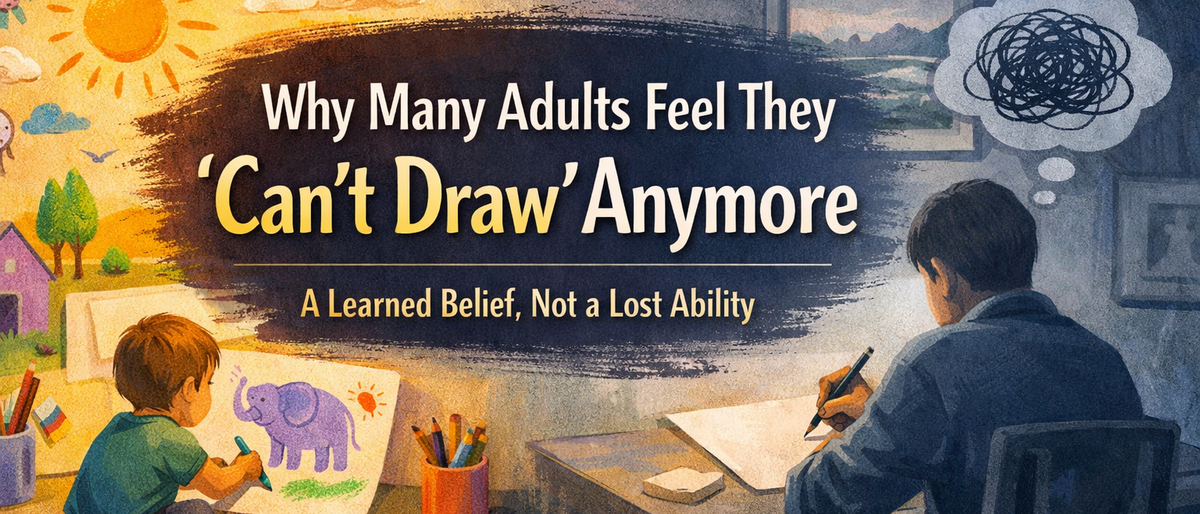
A Learned Belief, Not a Lost Ability
There’s a curious phenomenon that happens somewhere between childhood and adulthood: we stop drawing.
More precisely, we convince ourselves that we can’t draw.
Walk into any kindergarten classroom and you’ll see children creating with abandon—bold lines, strange proportions, impossible colors. Their drawings may not be realistic, but they are confident.
Ask those same people twenty years later to draw something, and the response is almost universal:
“I can’t draw. I’m not artistic.”
What actually happened in between?
The Moment We Decide We “Can’t”
For most people, the turning point arrives around age nine or ten.
This is when children begin to notice realism. They compare what’s on the page with what’s in front of their eyes—and realize the two don’t match. The problem isn’t the mismatch itself. The problem is the conclusion we draw from it.
Instead of understanding that skill develops through practice, many children interpret this gap as proof of missing talent. And so, at the exact moment when drawing requires more repetition to improve, practice stops.
Artistic ability doesn’t disappear—it freezes.
If we treated music the same way, most adults would say they “can’t play piano” simply because they stopped lessons after their first difficult year.
The Tyranny of “Good” Drawing
Modern culture has a narrow definition of what counts as “good” drawing:
accurate proportions, clean technique, photorealistic results.
But realism is only one small corner of what drawing can be.
When adults compare their early attempts to professional-level work—or even to peers who kept practicing—the comparison is crushing. The result is a self-protective belief:
“I’m just not creative.”
Over time, this belief hardens into identity. What began as a temporary skill gap becomes a permanent self-description.
Why School Didn’t Help
Another reason adults stop drawing is structural: art quietly disappears from education.
Math, language, and science remain mandatory year after year. Art becomes optional—and optional is rarely treated as essential. The implicit lesson is clear: creativity is a bonus, not a core human skill.
Even when art classes exist, they often emphasize finished results over exploration. Students who lack technical confidence feel exposed rather than supported. The message becomes:
Art is something you either have or you don’t.
In reality, it’s something you build.
The Adult Brain’s Hidden Obstacle
Adults don’t struggle with drawing because their hands stopped working.
They struggle because their inner critic got louder.
Children draw intuitively. Adults draw analytically.
Every line is evaluated mid-stroke. Every imperfection triggers self-correction. The same cognitive skills that make adults effective at work—analysis, judgment, precision—interrupt creative flow.
The issue isn’t ability. It’s constant self-surveillance.
The Fear of Being a Beginner
Drawing is uncomfortable for adults because it forces us into beginner status.
We’re used to competence. We expect results. Drawing, however, demands patience and tolerance for awkwardness—especially because it looks like something that should be easy.
Children draw without shame. Adults draw with comparison.
And when something feels simple but isn’t, shame grows quickly. Instead of accepting the learning curve, many people opt out entirely.
What We Lose When We Stop Drawing
The loss isn’t just artistic.
Drawing is a way of slowing down and truly observing. It trains visual thinking, regulates emotion, and offers a nonverbal outlet for stress. When adults stop drawing, they don’t just lose a hobby—they lose a form of engagement with the world.
Worse, the belief “I’m not creative” quietly spills into other areas of life, making people less willing to experiment, express, or try.
“I Can’t Draw” Is a Learned Belief
The good news is simple: learned beliefs can be unlearned.
Creativity doesn’t vanish with age. The adult brain remains plastic, capable of acquiring new skills when the environment feels safe enough to practice.
The real challenge isn’t talent—it’s finding a way back that doesn’t trigger judgment.
Re-Entering Through Structure: Why Paint by Numbers Works
For many adults, the hardest part of drawing isn’t the brush—it’s the blank page.
This is where paint by numbers becomes a surprisingly effective re-entry point.
Modern paint by numbers kits function less like coloring books and more like structured learning systems. They remove the two biggest sources of anxiety: composition and color choice. What remains is the act of painting itself—observing, layering, slowing down.
As you work, you begin to internalize fundamentals naturally: light and shadow, warm and cool tones, how small details serve the whole image. These principles stop being abstract ideas and become embodied understanding.
For adults who feel overwhelmed, starting with the right difficulty level matters. Choosing a design that matches your patience and experience makes the process supportive rather than frustrating. A clear breakdown of difficulty options can help you start without pressure or overcommitment, as explained in this guide on how to choose the right paint by numbers difficulty:paint by numbers buying guide
Just as important is understanding how to approach the process itself. Learning simple techniques—brush control, layering order, drying time—can dramatically improve confidence. A step-by-step explanation of the workflow is available in this paint by numbers process guide, which helps adults focus on progress instead of perfection.
For those specifically returning to creativity later in life, paint by numbers offers something rare: permission to practice without being judged. It’s not about proving talent—it’s about rebuilding trust in your ability to learn.
If you’re looking for options designed specifically for adult beginners and returning creatives, you can explore curated kits on the paint by numbers for adults page, created with complexity, pacing, and emotional experience in mind.
Final Thought
The child who could draw never disappeared.
They were simply taught to stop trying.
Relearning to draw isn’t about becoming an artist.
It’s about reclaiming a basic human capacity—to observe, to make, and to express without fear.
You don’t need talent to begin.
You need a way to start that lets you stay.